

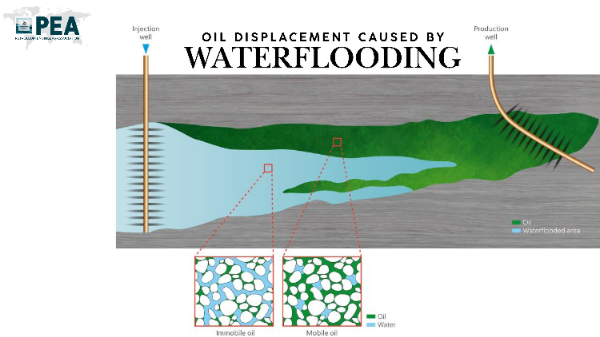
Oil displacement caused by waterflooding (large scale and pore level)

By Sonu Tewatia
mn,m,

By garishma
ggggggggggggggggg

Waterflooding
Waterflooding is injecting water into the oil reservoir to enhance oil recovery.
Waterflooding process remains the most widely used fluid injection technique.
This is mainly due to the following reasons:
• Water is generally easily accessible.
• Water injection is relatively low cost compared to other injection fluids.
• Injecting water into a formation is straightforward.
• Water is highly efficient in displacing oil during the recovery process.
For determining whether a reservoir is suitable for waterflooding improved oil recovery, the following are the main characteristics that must be taken into account:
Reservoir geometry: Geometrical characteristics of the reservoir will affect both the location of wells and the number of platforms that will be required. In order to determine whether there is a natural water drive and whether it should be enhanced or not, it is important to analyze the reservoir geometry and previous reservoir performance. In the case of water-drive reservoirs classified as active water drives, the injection may not be required.
Fluid properties: Oil viscosity and density are the most important fluid properties which determine the oil mobility ratio, which in turn determines its sweep efficiency. The higher the oil viscosity, the more difficult it will be to displace oil with water. Similarly, if the density of the injected water is higher than the oil, it may not effectively displace the oil from the reservoir.
Reservoir/rock properties: The characteristics of the reservoir, such as permeability, porosity, and reservoir pressure, are essential factors in determining if waterflooding is a viable option. The reservoir needs to have sufficient permeability to allow the injected water to flow through the rock and displace oil from the reservoir rock. Additionally, the porosity of the reservoir must be high enough to hold and release sufficient amounts of water.
Reservoir depth: The depth of a reservoir is important in both the technical and economic aspects of oil recovery projects. It will be difficult to tolerate the maximum economic water oil ratios in very deep wells, which will reduce the ultimate recovery factor and increase overall project operational costs. On the other hand, shallow reservoirs have a limited injection pressure since the pressure must be less than the fracture pressure. The critical pressure gradient of water flooding operation is approximately 0.23 bar/m in depth. If the operational pressure gradient exceeds the critical value, this causes fractures and results in injected water channeling. To prevent this, the operational pressure gradient of 0.17 bar/m is usually set as a safe margin.
Fluid saturations: In order for waterflooding operations to be successful, a reservoir must have a high oil saturation that provides sufficient recoverable oil. In terms of oil recovery potential, waterflooding is not as effective as polymer flooding (chemical) methods, and a part of immobilized oil may remain in the well even after the injection. This implies that the use of water flooding is suitable for high oil-saturated reservoirs.
Reservoir Heterogeneity: Reservoir heterogeneity refers to the variation of rock and fluid properties within the reservoir. When a reservoir is heterogeneous, some parts of the reservoir may be more accessible to the injected water, and others may be less accessible, leading to uneven oil displacement and reduced oil recovery.
Related Blogs:

- Company Articles
- 30th September, 2025
Optimizing Bottom Hole Assembly (BHA) Performance with Real-Time Data: A Game Changer for Drillers
In the oil and gas industry, understanding the performance of the Bottom Hole Assembl...

- Company Articles
- 30th September, 2025
Key Takeaways | Innova Tech Showcase 2025
Introducing Well Seeker XAt the forefront of our showcase was the launch of Well Se...


Leave a comment on this Blog/Article.